
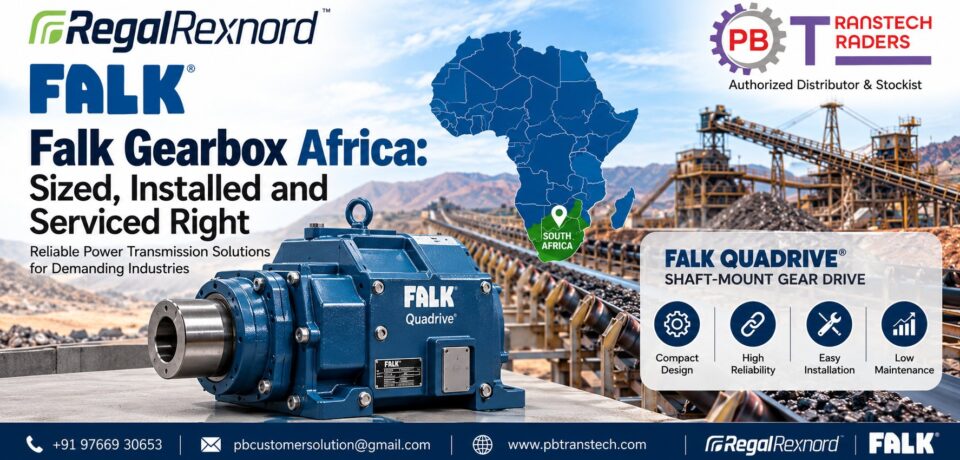
Falk Gearbox Africa: Sizing, Installation and Service Guide
Quick answer: Falk gear drives, part of the Regal Rexnord range, are used on demanding mining and bulk handling duties such as conveyors, mills and crushers. Long life depends on correct sizing with a service factor that matches the duty, careful installation and alignment, clean oil at the right level, and regular checks for leaks, noise, temperature and oil condition.
Falk gearbox Africa applications include some of the most demanding drives in industry. Conveyors, grinding mills, crushers and kiln drives run for long hours under high torque, shock loads, dust and heat. Getting the sizing, installation and service right is what keeps a gear drive in service for years rather than months. This guide covers the key points for Falk gear drives used across African mining and bulk handling.
Where Falk gear drives are used
Falk gear drives are part of the Regal Rexnord product range, and they are typically applied to heavy-duty drives where shock loads, high torque and continuous running are normal. In African mining and bulk handling, that often means conveyor drives, grinding mills, crushers and kiln drives.
Gearbox support in Southern Africa is not only about the product. Local assembly, testing, commissioning and repair services matter when a drive is down. A 2021 Mining Weekly article on local gearbox solutions for Southern Africa describes how these services support mining customers. Mining Weekly, “Local content drives gearbox solutions for Southern Africa”, 4 November 2021.
Falk gearbox Africa sizing: matching the drive to the duty
Correct sizing starts with the driven load. Record the required torque, speed, power, the number of starts per hour, and whether the load is smooth or shock-loaded. Apply the service factor that matches the duty, and check the thermal rating if the drive runs for long periods without rest.
| Duty factor | Question to answer | Why it matters |
|---|---|---|
| Load type | Is the load smooth, moderately shocked or heavily shocked? | Shock loads demand a higher service factor |
| Starts per hour | How often does the drive start under load? | Frequent starts add heat and torque peaks |
| Running hours | Is operation continuous or intermittent? | Continuous duty needs thermal margin |
| Ambient conditions | What are the dust, heat and humidity levels on site? | Heat reduces oil life and cooling capacity |
| Radial and axial loads | What belt or chain tension and thrust act on the output shaft? | Overhung loads can damage bearings and seals |
Undersizing is a common cause of early gear failure. A drive that runs close to its limits runs hotter, wears faster and has little margin for overloads. If the duty is uncertain, share the full application details with your supplier before ordering.
Installation and alignment
Good installation protects the gears and bearings from the start. The base must be rigid and level, and mounting bolts must be tightened to the specified torque. Alignment between motor, gearbox and driven machine should be checked carefully. Misalignment adds load to bearings and seals and causes noise, heat and early wear.
- Check the base for flex before bolting the gearbox down.
- Follow the coupling manufacturer’s alignment limits where a coupling links the drive to the load.
- Record alignment readings at commissioning as the baseline for future checks.
- Re-check the mounting after the first few weeks of operation.
Lubrication and oil analysis
Use the oil grade and viscosity specified for the gearbox and the operating temperature. Check levels regularly and change the oil at the manufacturer’s interval, adjusting that interval using oil analysis results. Severe duty, high temperature or contamination may require more frequent changes.
Oil analysis gives early warning of wear and contamination. Sampling at planned intervals can reveal metal particles, water and dirt before they damage the gears. Keep the results in a log so trends are easy to see.
Avoid mixing oil types, because this can reduce additive performance. Store oil in clean, sealed containers and filter it when transferring to the gearbox. Check breathers regularly, since a blocked breather builds pressure that can push oil past the seals.
Falk gearbox Africa commissioning checklist
Commissioning is the point where many long-term problems are either prevented or built in. Before the first run, confirm the mounting is level and bolted to the specified torque, the coupling alignment is within limits, and the oil level and grade match the nameplate. Record these readings in the maintenance file.
Run the drive unloaded first, then bring it up to load in steps while listening for noise and watching temperature. Check for oil leaks after the first hours of running and again after the first full shift. Any unusual noise or heat at this stage should be investigated before the drive is loaded fully.
Keep the commissioning readings as your baseline. A later reading that differs from the baseline is far easier to interpret than a single reading taken with no reference, and it shows whether wear, misalignment or contamination is developing.
Our guide to mining conveyor bearings in South Africa covers the bearings that often sit alongside these drives, and our industrial bearings supplier guide explains how to source them.
Common Falk gearbox failures and how to prevent them
- Overloading during start-up: check starting torque and cushioning during commissioning.
- Repeated shock loads: these can crack teeth or damage bearings over time.
- Oil leaks: usually worn seals, a damaged shaft surface or a blocked breather.
- Misalignment and loose mounting: these cause bearing heat, gear noise and uneven tooth load.
Most of these failures come down to basics: correct sizing, careful installation, clean oil and regular checks. A short, consistent routine is more effective than an occasional deep inspection that gets skipped when production is busy.
A maintenance schedule that works on site
| Frequency | Task |
|---|---|
| Each shift | Look for leaks, unusual noise and temperature rise |
| Weekly | Check oil level and breather condition |
| Monthly | Review temperature and vibration trends on critical drives |
| Planned intervals | Take oil samples for analysis; inspect seals and mounting bolts |
| Major stop | Check alignment, and inspect gears and bearings where access allows |
Keep one maintenance file for each gear drive that records nameplate data, commissioning readings, oil changes and repairs. When a replacement is needed, the file shows the correct specification and avoids guesswork during an urgent repair.
Record the source and date of every replacement part as well as its part number. If a gear drive fails again within a short period, that history helps the team tell whether the cause is the part, the installation, the lubrication or the duty. Without it, the same fault can be repaired several times without anyone finding the root cause.
Train the people who check the drive, not just the people who repair it. Operators who know what normal noise, temperature and oil level look like will spot a change early. A short checklist posted at the drive, with the normal readings written on it, turns routine walk-rounds into a reliable early warning system.
Keeping genuine parts in service
Replacement bearings, seals and gears should match the original specification. Parts that do not match can change clearances, loads and lubrication behaviour. Before fitting any replacement, check the part number, dimensions and documentation. Our guide on how to avoid counterfeit bearings in Africa explains how to check incoming parts.
For broader plant reliability planning, read our article on how to reduce plant downtime in Africa. P.B. Transtech supplies industrial power transmission products, and our team can help confirm the right specification for your drive.
Frequently asked questions
What information do I need to size a Falk gear drive?
Provide the required torque, speed, power, duty cycle, start frequency, shock level, output loads and ambient conditions. The more detail you share, the more accurate the sizing check.
How often should gearbox oil be changed?
Follow the manufacturer’s recommended interval and adjust it using oil analysis results. Heat, shock loading and contamination can shorten oil life.
What causes early gearbox failure?
Undersizing, misalignment, poor lubrication and contamination are the most common causes. Regular checks and oil analysis catch most of these early.
Is Falk part of Regal Rexnord?
Falk is part of the Regal Rexnord product range. Confirm the exact model and part number with your supplier before ordering replacements.