
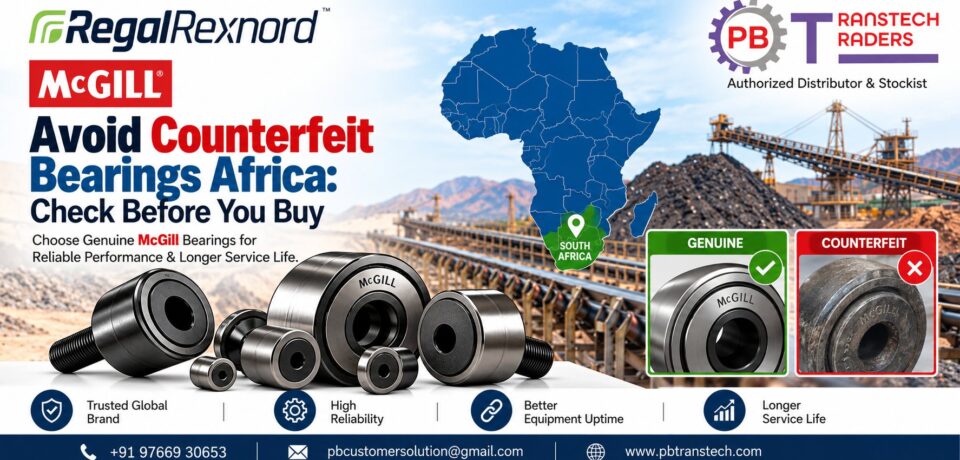
Avoid Counterfeit Bearings Africa: A Buyer’s Checklist for Plant Teams
Quick answer: Counterfeit bearings look like genuine parts but are often made with weaker steel, poorer heat treatment or inaccurate tolerances. Trade press in South Africa reports that counterfeits are not covered by the brand owner’s warranty, so a failure can cost far more than the part. Check markings and packaging, ask for traceable documentation, compare specifications, and buy from suppliers who can show where their stock comes from.
Counterfeit bearings are one of the quiet risks in African industry. They look almost identical to genuine parts, sell at lower prices and can arrive through channels that seem legitimate. When they fail, they can damage shafts, housings and drives, turning a small replacement into a costly shutdown. This checklist shows you how to avoid counterfeit bearings Africa-wide before the parts reach your plant.
Why counterfeit bearings are a concern in South Africa
South African trade press has reported that counterfeit bearings have become increasingly common in the local bearings market. In a November 2022 Engineering News article, a bearing supplier’s product manager said counterfeits can increase downtime, cause consequential damage and reduce bearing life and safety. He also said counterfeit bearings are not covered by any warranty from the brand owner, which undermines service contracts and leaves plants carrying the full cost of a failure.
The same article did not publish figures on how widespread counterfeiting is. Buyers should treat the risk as real but unmeasured, and build their checks around the warning signs below rather than around a guess about how many fakes are in circulation. Engineering News (Creamer Media), “Counterfeit bearings prominent in local industry”, 11 November 2022.
What counterfeit bearings look like
Counterfeits copy the outside of a genuine product. The shortfall usually sits inside: steel quality, heat treatment, internal clearance, cage design and seal material. A counterfeit bearing may run quietly for days and then fail early, when its raceways wear faster or its seals no longer hold.
- An unusually low price compared with other quotes for the same part number.
- Missing, blurred or inconsistent markings on the bearing or the box.
- Packaging that looks copied, or that varies within a single order.
- No batch code or traceability information.
- A supplier who cannot name the source of the stock.
Check markings, packaging and dimensions
| Check | Genuine indicator | Warning sign |
|---|---|---|
| Brand and part number | Matches the manufacturer’s catalogue exactly, including suffixes | Suffix missing or different; part number not in the catalogue |
| Markings on the bearing | Clean, even printing that matches the box | Blurred, misspelled or inconsistent markings |
| Packaging | Consistent print quality and labelling across the order | Mixed packaging or copied logos |
| Dimensions | Bore, outside diameter and width match the manufacturer’s data | Measured dimensions outside the stated tolerance |
| Finish and rotation | Smooth rotation, even finish and clean raceways | Rough rotation, visible marks or uneven finish |
Measure dimensions with proper tools where you can. Keep packaging and labels until the bearing is installed and running correctly, so you have evidence if there is a problem later.
Ask for traceable documentation
A trusted supplier can show where the product came from. Ask for a certificate of conformity or a supplier declaration linking the batch to the manufacturer. Where the manufacturer offers product verification, use it. A supplier who avoids these requests is telling you something important about the stock.
Compare specifications, not just prices
Price alone is a poor guide. A bearing that costs far less than the rest of the market may use lower- grade steel or looser tolerances. Compare the basic load rating, speed limit and seal type on the datasheet. If the figures are missing, or do not match the part number, treat that as a warning.
Basic rating life is estimated using the method in ISO 281. A bearing that falls short of its stated rating will not perform as expected under the same duty, even if it looks identical to a genuine part.
Red flags during the buying process
Some warning signs appear during the purchase rather than on the bearing itself. Be cautious if a supplier asks for payment before documents are provided, offers unusually large stock on demand, or will not name the source of the goods. Last-minute changes to the delivery address, unmarked shipping cartons and pressure to decide quickly all deserve a closer look.
Compare what you receive with what you ordered. Check quantities, part numbers and packaging on arrival, and record any mismatch with photographs. Quick, documented checks at receipt make it much easier to act if a problem appears later.
What a counterfeit failure really costs
The bearing is usually the smallest cost. A failure can damage the shaft, housing, seals and adjacent components. It adds labour for removal, lost production and, often, an emergency purchase at a higher price. If the brand owner’s warranty does not cover the part, the cost of the failure falls entirely on the buyer.
How to avoid counterfeit bearings Africa operators can apply on the next order
Turn the checklist into a routine you can apply on every purchase order. Before sending the order, confirm the part number, dimensions and documentation you need. On delivery, check quantities and packaging against the order. Before fitting, inspect the bearing for finish and rotation, and keep the packaging with the maintenance record. If you cannot complete a step, do not fit the part. Hold it, contact the supplier and escalate to the technical team. A short delay costs far less than a failure in service, and a supplier who respects this process is one you can plan around.
Our guides on choosing a South Africa bearing supplier and choosing an industrial bearings supplier in South Africa explain how to set up that supplier check. For downtime planning that reduces emergency buying, see how to reduce plant downtime in Africa.
Build a simple purchasing policy
Write down a short policy that every buyer and technician follows, including during urgent orders. It should cover four things: an approved supplier list, the documents required for each order, a receiving check that compares quantity, part number and packaging, and where the records are kept alongside maintenance history.
Planning replacements in advance reduces the pressure that drives poor purchasing. Our guide to mining conveyor bearings in South Africa covers how to schedule replacements so that urgent buying is the exception.
P.B. Transtech supplies industrial power transmission products for African buyers. Our team can review your part numbers and specifications before you order. For more on sourcing across markets, see our industrial couplings supplier guide for Africa.
Frequently asked questions
How can I tell if a bearing is counterfeit?
Compare markings, packaging, part number and dimensions with the manufacturer’s standard, check finish and rotation, and ask the supplier for traceable documentation. Unusual prices and missing paperwork are warning signs.
Is a cheaper bearing always a fake?
No, but a price far below the market is a reason to ask more questions. Compare load ratings, seal types and documentation before you decide.
How do I avoid counterfeit bearings Africa-wide on a tight deadline?
Use the same checklist even when the order is urgent. Confirm the part number, check the documentation and inspect the parts on arrival. If the paperwork is missing, hold the part and escalate, because an urgent order from an unknown source is a common route for counterfeits.
Are counterfeit bearings covered by the brand warranty?
A South African bearing supplier quoted in Engineering News said counterfeit bearings are not covered by the brand owner’s warranty. Check the warranty terms for the specific products you buy.
What should I do if I suspect a counterfeit part?
Stop using it, keep the packaging and records, contact the supplier and the manufacturer, and document the failure so the batch can be traced.
References
- Engineering News (Creamer Media), “Counterfeit bearings prominent in local industry”, 11 November 2022.
- ISO 281: Rolling bearings, dynamic load ratings and rating life, International Organization for Standardization.