Bottling Line Clutch & Brakes Kenya: Complete Technical & Business Guide
Bottling line clutch and brakes Kenya: complete technical & business guide to precision engagement systems for high-speed beverage manufacturing.
Executive Summary
Kenya’s beverage manufacturing sector has emerged as one of Africa’s most sophisticated and technologically advanced industrial operations. This comprehensive technical guide addresses the mission-critical challenge of bottling line clutch and brakes in Kenya — precision clutch and brake system selection, installation, and maintenance for high-speed bottling operations. Whether you operate a single bottling line or manage multi-facility beverage production networks across Kenya, Tanzania, Uganda, or DRC markets, this resource provides authoritative technical information, financial analysis, and practical decision-making frameworks.
Industry Overview: Kenya Beverage Manufacturing Sector
The East African beverage manufacturing industry represents one of the continent’s most dynamic and growth-accelerating sectors. Kenya specifically commands significant market position with production capacity exceeding 2.1 billion liters annually across diverse beverage categories: carbonated soft drinks (Coca-Cola Kenya produces approximately 800+ million liters annually), alcoholic beverages (Diageo East Africa manufactures Guinness, Johnnie Walker, and other spirits within Kenya), non-carbonated beverages (fruit juices, water, ready-to-drink tea), and energy drinks.
Industry Scale & Economic Impact
Kenya’s beverage manufacturing sector directly employs 8,500+ skilled and semi-skilled workers across bottling facilities, packaging operations, quality assurance, and distribution centers. Broader economic contribution reaches approximately $1.2 billion in annual GDP contribution through direct production value, employment income multipliers (estimated 3-4x direct employment impact through supply chains), tax revenue contribution to national government, and supply chain activation across packaging manufacturers, ingredient suppliers, and logistics providers.
Geographic Production Distribution: Nairobi (primary hub, ~45% of national capacity), Mombasa (port-adjacent production, ~20%), Kisumu (West Kenya capacity, ~15%), Eldoret (highlands region, ~12%), other locations (8%). This geographic distribution requires supply chain coordination across Kenya’s industrial regions with varying infrastructure capabilities and technical support availability.
Market Competition & Growth Drivers
Kenya-based beverage manufacturers compete not only domestically but increasingly across East Africa and export markets. Regional competitors from Uganda, Tanzania, Rwanda, and South Africa actively pursue Kenya market share and East African distribution rights. Competition manifests through continuous capacity expansion (new production lines), process automation and efficiency improvements, product innovation (new beverage formulations), and cost reduction initiatives. This competitive environment creates powerful incentives for equipment reliability and production efficiency improvements.
Operational Requirements: Three Critical Pressures
Pressure 1: Product Consistency & Quality Assurance
Modern beverage consumers expect absolute consistency across multiple product dimensions. Fill level consistency (within 2mm tolerance), cap tightness consistency (within specified torque ranges), label alignment precision, and consistent product appearance represent baseline consumer expectations. Quality inconsistencies create cascading business problems:
- Product waste – liquid loss during filling, wasted packaging materials
- Brand reputation damage – consumer perception of quality decline circulates through social media and reviews
- Regulatory compliance violations – beverage regulations specify fill accuracy and nutritional labeling precision
- Safety concerns – overfilled or underfilled bottles create safety issues during distribution and consumption
Kenya’s competitive market environment means single quality failures rapidly translate to measurable market share losses. Kenafric Industries, for example, competes directly with Coca-Cola Kenya for premium juice market share. Quality failures damage brand positioning and create switching opportunity for competitors. Clutch and brake system failures are primary contributors to quality inconsistencies—slow engagement creates systematic underfill patterns, brake slip causes labeling misalignment, and uncontrolled stops generate bottle damage.
Pressure 2: Production Speed & Line Velocity
Contemporary high-speed bottling lines operate at dramatically elevated speeds compared to equipment from even 3-5 years ago. Modern production specifications:
- Standard lines: 1200-1800 bottles/minute
- Premium high-speed lines: 1800-2400 bottles/minute
- Multi-head lines: capability to reach 2400+ bottles/minute
At these velocities, clutch engagement timing becomes absolutely critical. Engagement must occur within precise millisecond windows—typically 30-50 milliseconds. Delays of merely 50ms (one-twentieth of a second) at 2000 bottles/minute production rate translate to 1.67 bottle positions—enough to create systematic misfeed patterns affecting downstream capping, labeling, and case packing operations.
Speed-related failures cascade through production systems. An engagement delay at the primary filler creates initial positioning errors. These errors cascade to capping stations where caps misalign, labeling equipment applies labels to wrong positions, and case packing systems encounter mechanical jams. What begins as a 50ms engagement delay often results in complete line shutdown lasting 30-60 minutes as operators diagnose root cause and clear jammed bottles from the line.
Pressure 3: Economic Efficiency & Cost Management
Beverage manufacturing operates on notoriously tight margins—typically 12-18% EBITDA margins after accounting for raw materials (45-55% of revenue), labor (15-20%), facility costs (8-12%), and distribution (10-15%). This margin structure means production efficiency directly determines business profitability. Financial impact of downtime:
- Five hours of annual downtime = Rs. 2,50,000-3,75,000 in lost production revenue
- Twenty hours of annual downtime = Rs. 10,00,000-15,00,000 in lost revenue
- Fixed facility overhead continues (~Rs. 25,000-50,000/day)
- Staff wages continue (~Rs. 15,000-30,000/day)
- Maintenance crew overtime costs (~Rs. 10,000-20,000/incident)
- Customer delivery failures and penalty costs (~Rs. 50,000-100,000+ per delayed shipment)
Cumulative true downtime cost typically reaches Rs. 1,00,000-2,00,000 per hour—exceeding direct production loss by 2-3x.
Bottling Line Clutch and Brakes Kenya: Engineering & Technology
Air-Engaged Clutch Systems: Technical Specifications
| Specification | Typical Range | Kenya Bottling Application | Performance Impact |
|---|---|---|---|
| Engagement Time | 10-100 milliseconds | 30-50 ms optimal | Synchronized multi-station operation, minimizes bottleneck |
| Torque Capacity | 5-500 N.m | 50-150 N.m | Handles typical conveyor inertia plus production momentum |
| Air Pressure | 0.5-6 bar | 2-4 bar standard | Compatible with typical factory compressed air systems |
| Slippage During Operation | 0% slip specification | Zero drift when engaged | Prevents bottle repositioning, maintains line synchronization |
| Temperature Stability | -20 to +60 °C | +10 to +50 °C typical Kenya | Year-round performance in Kenya climate variations |
| Actuation Response | <100ms response time | 30-50ms typical | Rapid engagement without shock load |
| Maintenance Interval | 1000-2000 hours | Filter/dryer service 6-12 months | Lower maintenance vs. friction clutches |
Spring-Applied Brake Systems: Fail-Safe Operation
Spring-applied brake systems employ fail-safe design principles where springs apply maximum braking force continuously. Compressed air or electrical power is required only to release the brake and permit rotation. This engineering approach ensures that loss of power (air pressure failure or electrical power loss) results in automatic full brake engagement—preventing uncontrolled drift. For Kenya operations where power infrastructure occasionally experiences interruptions, surge events, or voltage fluctuations, this fail-safe design provides critical protection.
Consequences of uncontrolled drift: Production line coasts to uncontrolled stop, 500-1000 bottles potentially damaged, operator safety hazard, downstream equipment damage potential. Economic consequence of single uncontrolled drift: Rs. 2,40,000-3,60,000 in bottle damage plus equipment damage plus production loss.
Financial Impact Analysis: Failure Costs & ROI Calculations
| Failure Type | Frequency | Bottles/Incident | Production Loss | Cost Impact (Rs.) | Annual Impact (Rs.) |
|---|---|---|---|---|---|
| Slow Engagement | 3-5x annually | 150-300 | 0.5-1.0 hours | 45,000-90,000 | 1,35,000-4,50,000 |
| Brake Slip (Cap) | 2-4x annually | 300-600 | 1-2 hours | 90,000-1,80,000 | 1,80,000-7,20,000 |
| Uncontrolled Stop | 1-2x annually | 800-1,200 | 3-6 hours | 2,40,000-3,60,000 | 2,40,000-7,20,000 |
| Partial Downtime | 1-2x annually | Entire run | 8-12 hours | 4,00,000-6,00,000 | 4,00,000-12,00,000 |
| Cumulative Baseline | ~25,000/year | ~20-30 hours | Rs. 9,55,000-31,90,000/year |
Premium Precision System Benefits: Premium Warner Electric systems reduce failure incidents by 95% compared to low-cost alternatives.
- System upgrade cost: Rs. 8,00,000-12,00,000
- Annual savings (95% reduction): Rs. 9,09,000-30,35,500
- Payback period: 3-13 months
- Post-payback annual margin benefit: Rs. 9,09,000-30,35,500/year
Installation Best Practices for Bottling Line Clutch and Brakes in Kenya
Correct installation is what allows bottling line clutch and brakes in Kenya to deliver their rated performance. Precision alignment represents the single most important installation factor. Shaft runout exceeding 0.5mm creates vibration, accelerated wear, and engagement failures. Installation procedure: use precision dial indicators mounted on shaft, measure runout at multiple points along shaft length, adjust flexible coupling or motor mounting to achieve runout <0.5mm maximum, and recheck after thermal stabilization.
Air supply quality determines long-term system reliability. Contamination (oil, water, particulate) causes failure within weeks. Standard Kenya industrial facilities often have air quality issues. Required approach:
- Install a 5-micron particulate filter immediately upstream
- Install a refrigerated dryer to remove moisture
- Service filter/dryer every 1000 operating hours or 6 months
- Monitor air pressure for stability (should not fluctuate >0.5 bar)
Electrical integration with PLC or mechanical timing ensures synchronized operation across multi-station lines. Standard integration requires 48 hours including sensor calibration, timing synchronization, load testing, and verification under full-speed operation.
Commissioning follows an 8-hour run-in protocol at 50% speed before permitting full-speed operation. Run-in allows components to settle, seal surfaces to establish proper contact, and the system to stabilize thermally.
P.B. Transtech: Authorized Kenya Distributor
Primary Phone: +91 9766930653
Secondary Phone: +91 9860131022
Email: pbcustomersolution@gmail.com
Main Website: https://pbtranstech.com/
Specialized Coupling Portal: https://regalrexnordcoupling.in/
Company Details
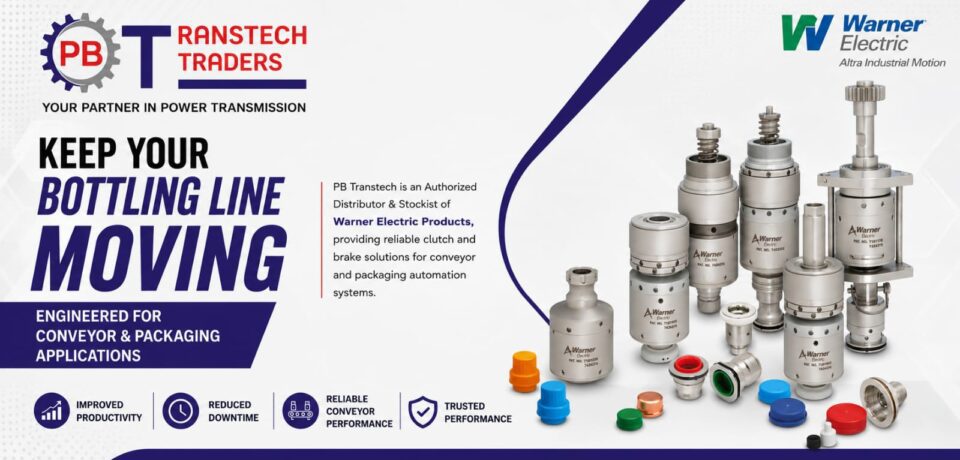
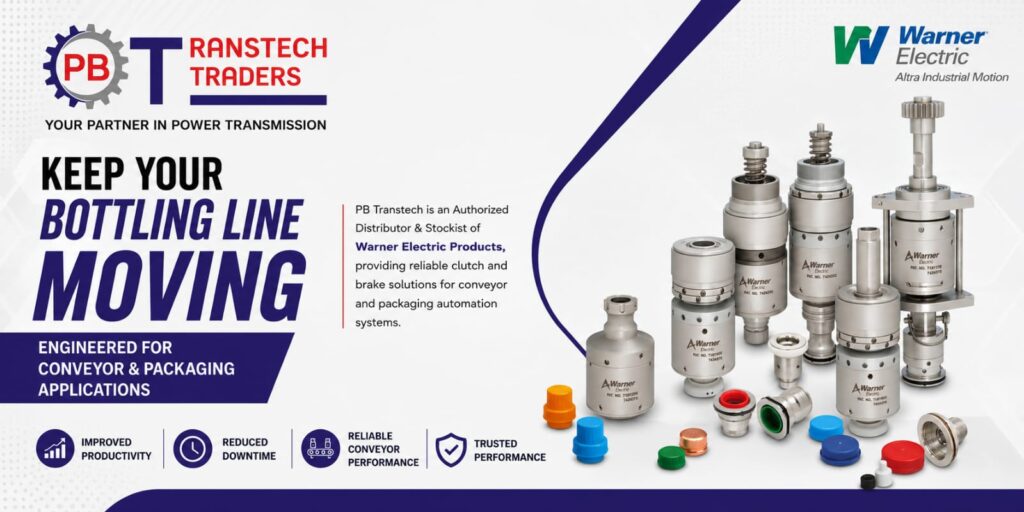
P.B. Transtech – Authorized Distributor of Warner Electric, Regal Rexnord, and 80+ Industrial Brands
Headquarters: Moshi, Pune, Maharashtra, India
Leadership: Mentor Savita Bhosale | CEO Abhijeet Bhosale
Sister Company: P.B. Traders
Kenya Operations: Stock positions in Nairobi, Mombasa | 24-hour emergency support | Technical commissioning services
Authorized Distributor Advantages
- Genuine warranty from manufacturer (counterfeit systems common in Kenya market)
- Stock availability in Nairobi for 24-hour emergency delivery (vs. 2-4 week import delays)
- Direct access to Warner Electric technical engineers
- Trained installation technicians certified for proper commissioning
- Competitive pricing through direct distributor relationship
Conclusion: Choosing Bottling Line Clutch and Brakes in Kenya
Bottling line clutch and brake systems represent mission-critical precision instruments that directly determine your production efficiency, product quality consistency, and ultimately your competitive position in Kenya’s beverage market. Premium precision systems deliver quantifiable financial benefits: Rs. 9,09,000-30,35,500 in annual savings through eliminated product damage, prevented downtime, and improved throughput efficiency. Total payback occurs within 3-13 months of operation—after which all efficiency gains become pure operational margin improvement.
P.B. Transtech’s authorized Warner Electric distributor partnership, Kenya-based inventory, factory-certified installation services, and 24-hour emergency support ensure your bottling line achieves target reliability performance. For Kenya beverage manufacturers operating in increasingly sophisticated competitive markets, premium precision systems for bottling line clutch and brakes in Kenya represent not a discretionary upgrade but a strategic necessity for sustainable competitive advantage.
Contact P.B. Transtech today to upgrade your bottling line precision systems and secure competitive advantage through operational excellence.
+91 9766930653 | pbcustomersolution@gmail.com | www.pbtranstech.com